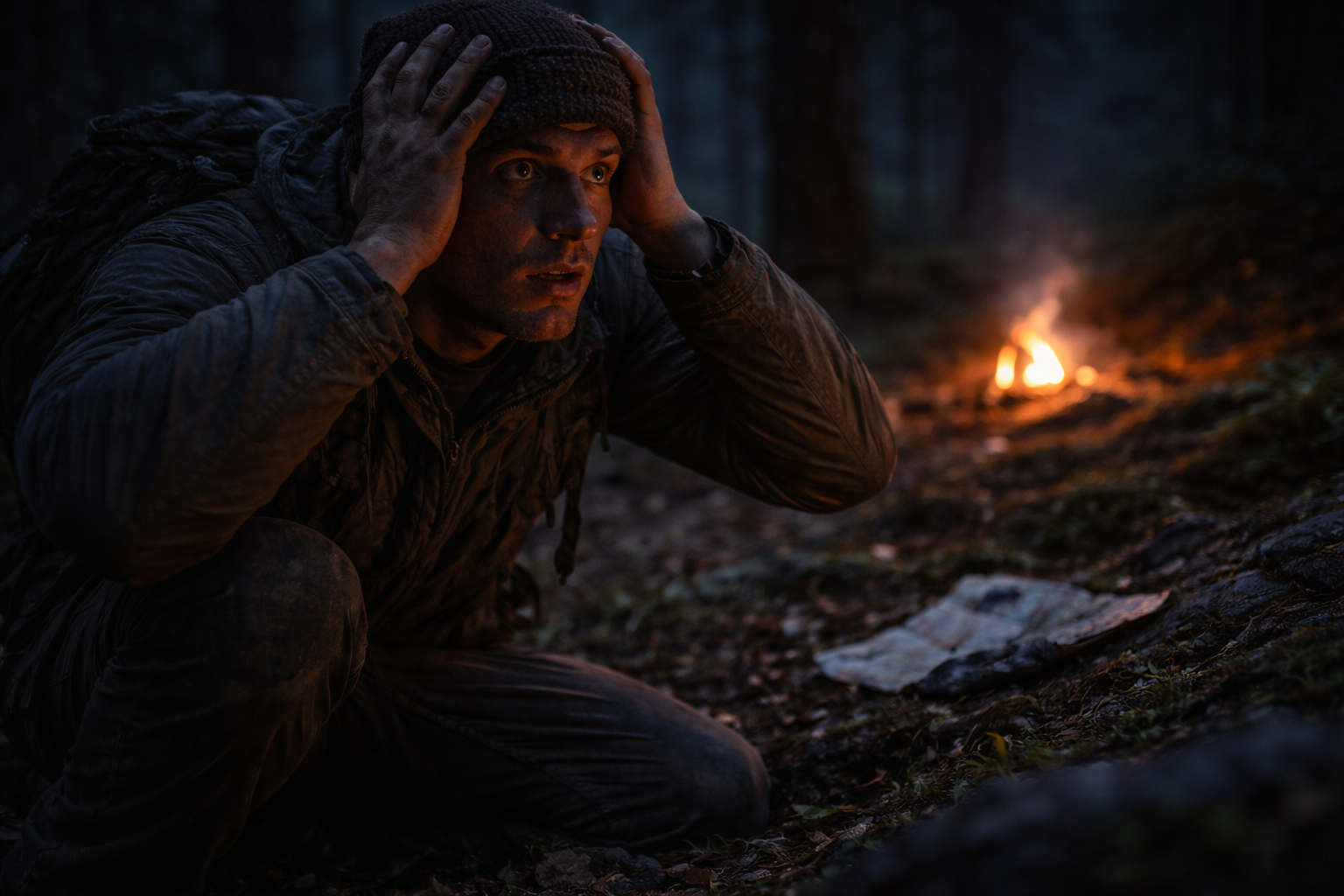
The Moment Panic Takes Control
Panic doesn’t feel like fear.
It feels like urgency.
Your brain flips into “do something NOW” mode. Logic shuts down. Time feels compressed. Small problems feel catastrophic.
This is when people:
- Run instead of stopping to think
- Burn calories they can’t afford
- Abandon tools they’ll desperately need later
- Walk past safety because it doesn’t look obvious enough
Survival panic is not screaming and chaos — it’s rushed confidence.
Why the Brain Betrays You
In modern life, stress usually has an immediate solution:
- Missed a bus → take another
- Lost signal → move 10 meters
- Problem at work → make a call
In the wild, this conditioning becomes lethal.
Your brain assumes:
“If I move fast and do something, the problem will end.”
But in survival, movement often creates the problem.
Most lost hikers are found past safe shelter.
Most dehydration deaths happen while “trying to get out.”
Most hypothermia cases begin with unnecessary motion.
The 3 Most Common Panic Mistakes
1. Directional Fixation
People pick a direction and commit emotionally — even with no evidence it’s correct. Turning back feels like failure, so they keep going… deeper.
2. Tool Neglect
Knives dropped. Backpacks abandoned. Fire-starting gear ignored. Panic narrows attention to movement, not preparation.
3. Energy Dumping
Running, climbing, shouting — burning calories and moisture when the body needs conservation.
Survivors don’t “push through.”
They slow down before it feels safe to do so.
The First Survival Skill Isn’t Fire or Shelter
It’s pause control.
Experienced survivors deliberately force a stop:
- Sit down
- Drink water
- Touch the ground
- Inventory gear slowly
This interrupts the panic loop.
The brain regains sequence thinking instead of reaction thinking.
That single pause can decide whether the next 72 hours are manageable — or fatal.
Primitive Rule That Saves Lives
Early humans didn’t rush into danger.
They waited, observed, and acted only when patterns became clear.
Modern survivors who live follow the same rule:
No major decision in the first hour.
No long movement in the first day.
Survival isn’t about bravery.
It’s about resisting the urge to feel productive.
Why This Matters More Than Gear
You can survive with poor tools and good judgment.
You will die with perfect gear and panic thinking.
The wilderness doesn’t punish weakness.
It punishes haste.
In the next post, we’ll break down how to deliberately shut panic down using simple primitive mental anchors — techniques humans used long before psychology had a name.