The Sky as a Map
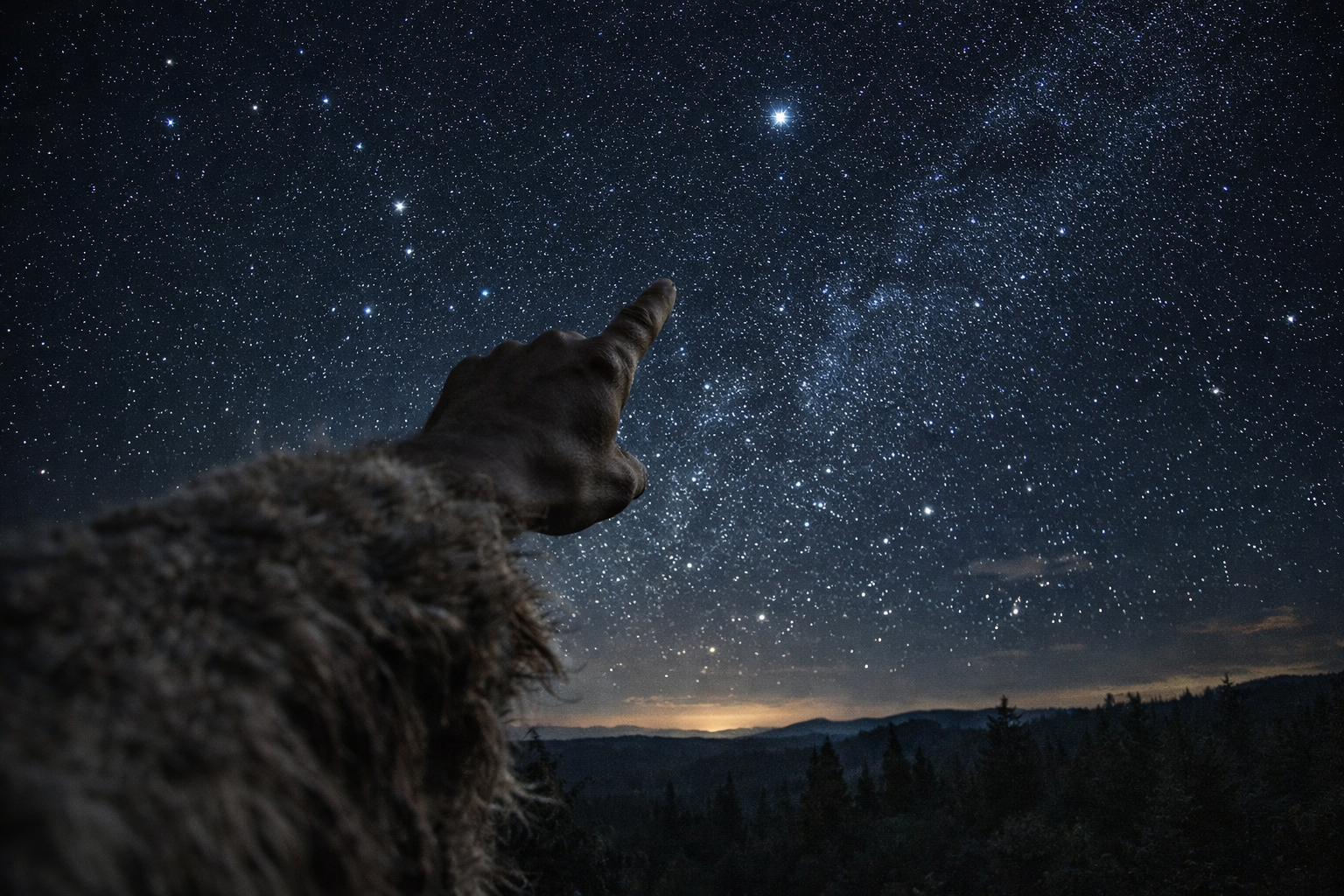
The night sky rotates in predictable patterns. While planets wander, the stars move in slow, steady arcs. Early travelers memorized these movements the way we memorize streets today.
The key concept: the sky turns, but directions stay the same.
If you understand that, the stars become fixed signposts rather than random lights.
Finding North Without a Compass
In the Northern Hemisphere, one star has guided travelers for centuries: Polaris, the North Star.
Polaris sits almost directly above true north and barely moves during the night. Once you locate it, you instantly know direction.
How ancient people found it:
-
Locate the Big Dipper
-
Follow the line formed by its two outer stars
-
Extend that line about five times its length
-
The first bright star you reach is Polaris
Face Polaris — you’re facing north. South is behind you. East is to your right. West to your left.
No batteries. No signal. No failure.
Navigating Without Polaris
What if Polaris is hidden or you’re in the Southern Hemisphere?
Humans adapted.
In the south, navigators used the Southern Cross constellation. By extending its long axis downward, they could estimate true south.
In any region, experienced travelers also used:
-
The arc of the Milky Way
-
The rising and setting points of major star groups
-
The rotation of the entire sky over several hours
Even without named constellations, repeated observation reveals patterns your brain naturally remembers.
Using Stars to Hold a Course
Primitive travelers didn’t constantly check direction. Instead, they chose a target star low on the horizon and walked toward it.
When that star rose too high or disappeared, they selected another star rising in the same direction.
This method allowed:
-
Straight-line travel over long distances
-
Silent movement at night
-
Reduced heat loss and dehydration compared to daytime travel
Many cultures preferred night travel for survival.
Clouds, Moonlight, and Backup Clues
Stars weren’t the only tools.
When clouds covered the sky, night travelers used:
-
Wind direction felt on the face
-
Terrain slope and ground texture
-
Moon phases and shadows
-
Animal movement patterns
Navigation was never about one method — it was about layered awareness.