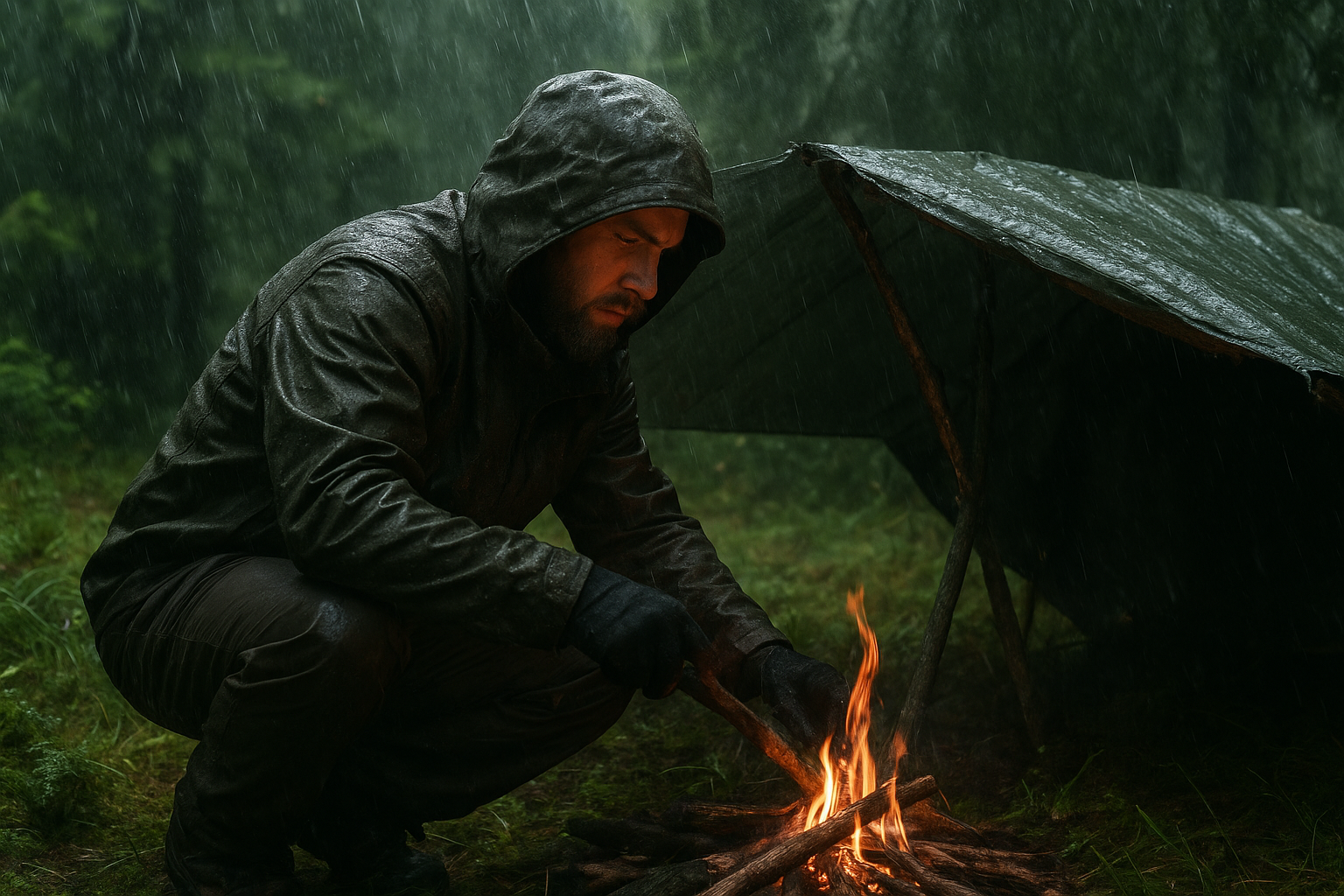

Why Wet Environments Are the Most Dangerous
Rain doesn’t just make you cold or uncomfortable — it amplifies every risk:
-
Hypothermia in mild temperatures
-
Slippery terrain and injuries
-
Rapid heat loss through soaked clothing
-
Difficulty lighting fire
-
Food spoilage and gear decay
-
Reduced visibility, navigation errors, and disorientation
This makes wet-climate survival one of the most important topics for bushcraft, search-and-rescue training, and wilderness preparedness.
This guide ensures you stay ahead of the elements.
1. Rainproof Thermoregulation: Staying Warm When Everything Is Wet
✔ Stay Dry From the Inside Out
Moisture inside your clothes is just as dangerous as rain outside.
A proper moisture-management system is essential:
-
Base layer: synthetic or merino wool
-
Mid layer: fleece or wool (retains heat when wet)
-
Outer layer: wind-resistant + water-resistant
-
Avoid 100% waterproof layers unless breathable — they trap sweat
✔ Emergency Warmth Techniques
If you’re already soaked:
-
Create a heat cocoon with pine boughs and your pack
-
Use hot rocks wrapped in cloth (never direct skin contact)
-
Use body insulation — dry leaves, moss, grass packed under shirt
-
Prioritize shelter and fire immediately
2. Building Effective Shelter in Constant Rain
✔ The 45° Rain-Shedding Rule
Any roof must be steep enough so water cannot pool.
Aim for 45–55 degrees minimum slope.
✔ Best Materials for Rainproof Natural Roofing
-
Fir boughs
-
Cedar bark strips
-
Large overlapping leaves
-
Birch bark
-
Spruce branches
Overlap layers like shingles — bottom to top — so water travels downward.
✔ Raised Bed = Zero Moisture
To avoid ground soak:
-
Build a 20–30 cm raised platform
-
Use logs or thick branches as a frame
-
Fill with soft boughs, dry grass, or moss
3. Fire in the Rain: The Skills That Separate Beginners From Survivors
Making fire in a wet forest is one of the hardest bushcraft tasks.
Here’s the proven method used by pros:
✔ Step 1: Collect the Dry Core
Even in pouring rain, dry material exists:
-
Inside dead standing trees
-
Beneath thick fallen logs
-
Under bark of pine, cedar, or birch
-
In pockets under large rocks or cliffs
Split wood to expose the dry core.
✔ Step 2: Create a Waterproof Fire Base
Use:
-
Bark sheets
-
Rocks
-
Thick logs
-
Your pack’s frame
A fire started on wet soil dies instantly.
✔ Step 3: Use High-Oil Natural Tinder
Best wet-weather tinders:
-
Birch bark
-
Pine resin
-
Fatwood
-
Dry inner cattail fluff
-
Feather sticks
✔ Step 4: Build a Reflector Wall
A wall of logs behind the fire:
-
Redirects heat to your body
-
Helps dry soaked clothing
-
Keeps flame alive during wind + rain
4. Navigation & Movement in Rain-Damaged Terrain
Rain changes landscapes quickly — streams swell, slopes collapse, paths turn to mud.
✔ Key Movement Rules
-
Avoid valleys, ravines, and riverbeds — flash flood danger
-
Walk ridgelines for stability
-
Use trekking stick to test ground
-
Wet logs and stones → assume slippery
✔ Navigation Without Landmarks
Fog and rain reduce visibility dramatically.
Use:
-
Tree moss growth direction (north side is denser in many regions)
-
Prevailing wind direction
-
Water flow to determine slope
-
Animal trails → usually lead to stable terrain
5. Food, Water & Gear Protection in Wet Conditions
✔ Keeping Gear Dry the Primitive Way
If you lack waterproof bags:
-
Wrap items in birch bark
-
Use pitch + charcoal mixture to seal seams
-
Use large leaves as moisture shields
-
Hang food high off ground to prevent rot
✔ Water Collection
Rain is the easiest clean-water source:
-
Use leaves as funnels
-
Create drip lines
-
Collect water off tarp or bark roofs
-
Use moss as a collector (squeeze into container)
✔ Food Safety
Wet climates spoil meat fast.
Use:
-
Smoking
-
High-salt brine
-
Drying racks near fire
Conclusion: Rain Survival Is About System, Not Strength
Mastering wet-environment survival is about:
-
Managing moisture
-
Controlling body temperature
-
Building smart shelter
-
Making fire despite rain
-
Navigating safely
-
Protecting gear and food
If you understand the rules of rain, you turn a hostile environment into one of the most resource-rich ecosystems for long-term survival.