
Cold doesn’t hit all at once.
It creeps in quietly. First your fingers lose sensitivity. Then your movements slow down. Then your thinking follows. And by the time you realize how cold you really are — you’re already in danger.
So the real skill is not just staying warm.
It’s recovering when you’ve already started losing heat.
The worst thing you can do is ignore it. Cold doesn’t “pass.” It builds. Every minute without action makes the next step harder.
Start with the basics: stop heat loss.
Get out of the wind immediately. Even a small barrier — a rock, a fallen tree, a slope — can make a difference. Wind strips heat faster than low temperature itself.
Then deal with moisture.
Wet clothing is your enemy. If you can, remove it, wring it out, replace it, or dry it near a fire. If you can’t, you still need insulation. Add layers. Even dry leaves or grass under your clothing can help trap heat.
Now comes movement — but controlled.
People make a mistake here. They either sit and freeze, or they overexert and sweat, making things worse. You need steady, moderate movement. Enough to generate heat, not enough to soak your body.
Your core is everything.
If your chest and torso stay warm, your body will fight to keep your extremities alive. Protect that area first. Wrap it, cover it, shield it.
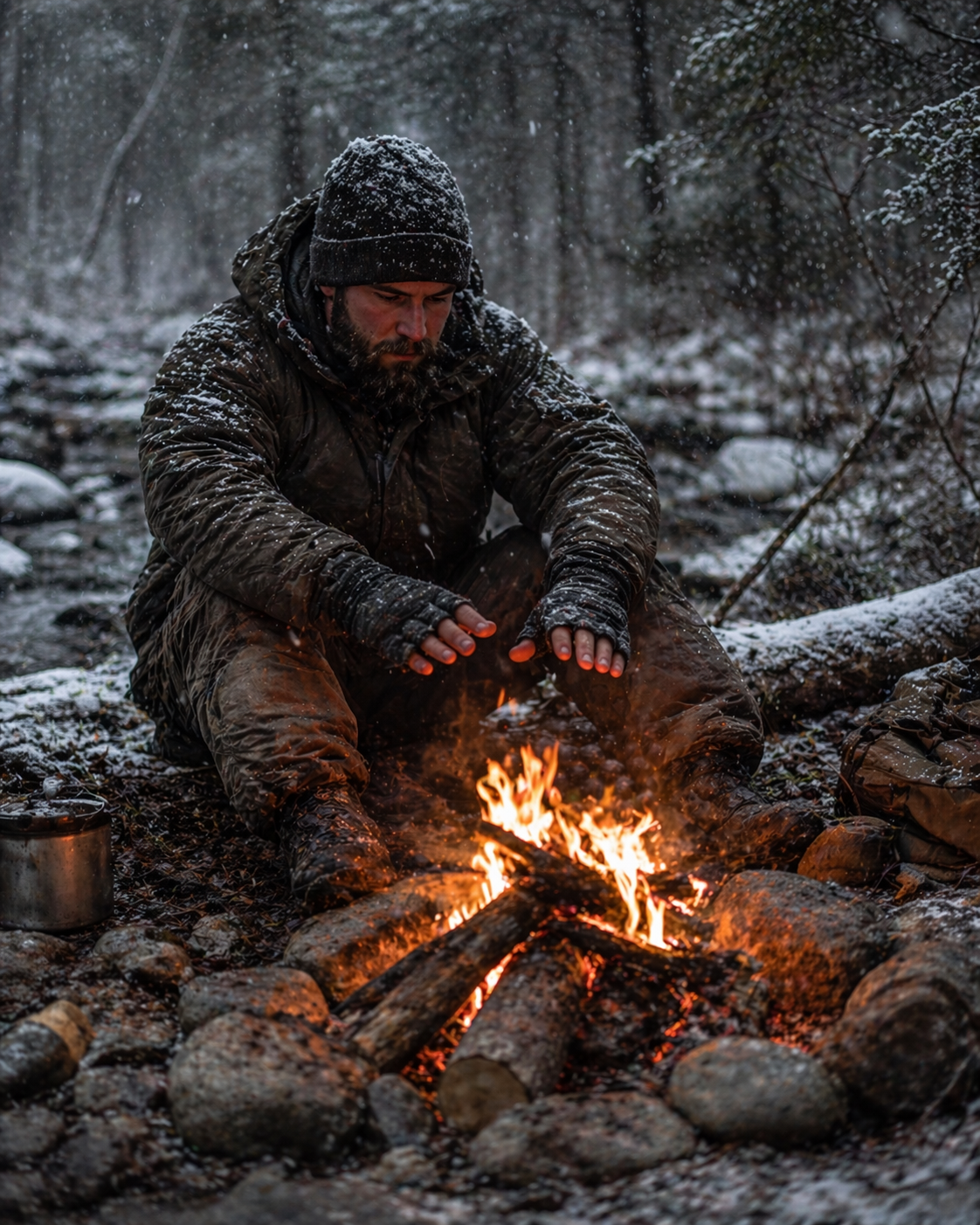
Fire, if you have it, is not luxury — it’s recovery.
But don’t sit too close trying to “feel warm.” Dry your clothes, warm your core, and manage your position. Fire is a tool, not a comfort.
And one more thing most people don’t understand:
Food matters more in the cold.
Your body burns energy faster trying to stay warm. Even small amounts of food can help maintain heat. Without fuel, your body has nothing to burn.
Cold survival is not about toughness.
It’s about reaction.
Because once your body crosses a certain line — it stops fighting back.