
Most people walk through the forest like it’s empty.
It’s not.
Every step you take crosses paths with animals you never see. Not because they’re rare — but because you don’t know how to look. The ground is a record of movement, and if you learn to read it, the forest stops being silent.
Tracks are not just footprints. They are stories.
Start with the basics: shape and pattern.
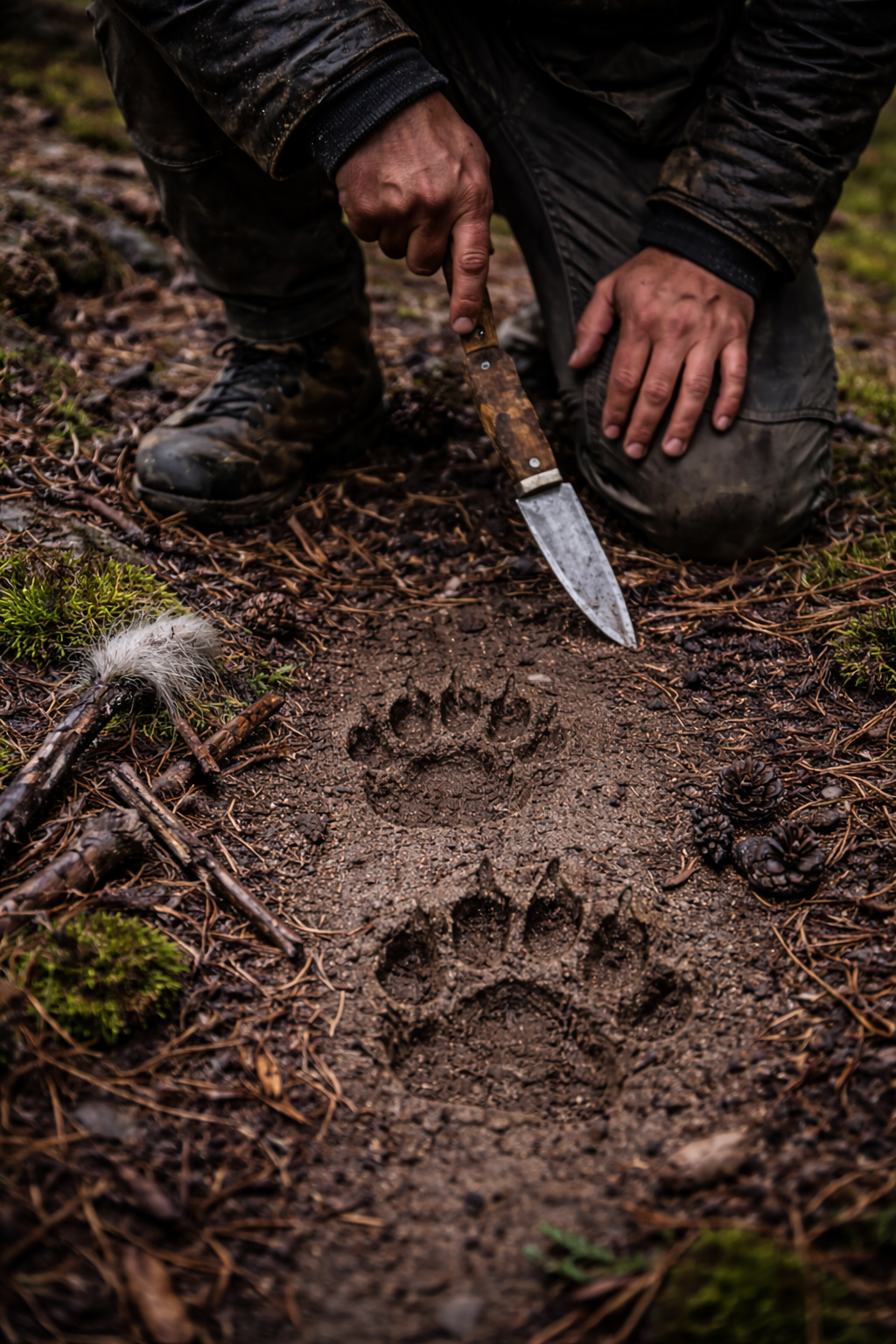
Hoof prints usually mean prey animals — deer, elk, something that runs more than it fights. Paw prints with visible claws often belong to predators or scavengers. The size tells you how big. The depth tells you how heavy. The spacing tells you how fast it was moving.
But the real skill is not in identifying the animal.
It’s in understanding what it was doing.
Are the tracks straight and steady? The animal was calm, moving with purpose. Are they scattered, uneven, circling? Something disturbed it. That means something else is in the area.
Freshness matters more than anything.
Sharp edges, clear detail, undisturbed ground — that’s recent. Wind-softened edges, debris inside the print — older. In survival, knowing when something passed is often more important than knowing what passed.
Look beyond the tracks.
Broken branches at height can tell you the size of the animal. Scratches on trees, disturbed soil, droppings — all of it builds a bigger picture. Tracks are just one piece.
And here’s the part people ignore:
You are also leaving tracks.
Anything that can read the ground knows you’re there. Most animals will avoid you. Some won’t care. A few might become interested.
That’s why awareness matters.
You’re not just reading the wild.
The wild is reading you back.