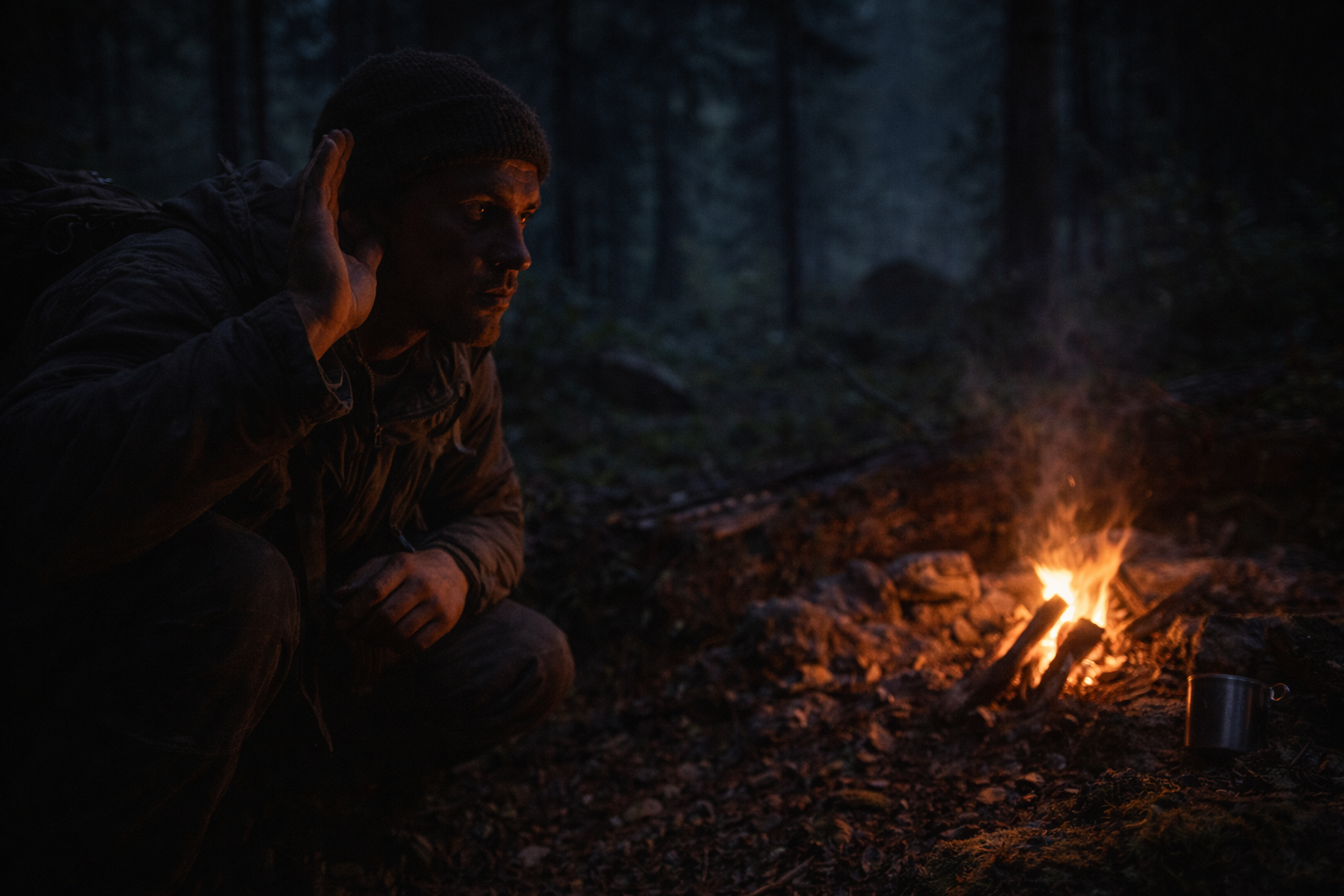
At night, your eyes stop being your primary survival tool.
Your ears, skin, and instincts take over.
Most people fear what they see in the dark — experienced survivors fear what they don’t hear.
Why Night Sounds Matter More Than Sight
In darkness:
-
Vision range drops to a few meters
-
Depth perception disappears
-
Movement becomes deceptive
But sound travels farther, clearer, and faster. The problem?
Most people don’t know how to interpret it.
Night survival isn’t about silence — it’s about reading the audio environment.
The Three Types of Night Sounds
Survivors mentally separate night noise into categories:
-
Constant sounds
Wind, insects, distant water. These form the “baseline.”
When the baseline changes — something moved. -
Rhythmic sounds
Footsteps, snapping branches, breathing patterns.
Nature is chaotic, but animals move with rhythm. -
Sudden silence
Often the most dangerous signal.
When insects stop at once, something entered the area.
Silence at night is rarely peaceful.
Sound Discipline: Don’t Announce Yourself
Many people give away their position without realizing it:
-
Crunching leaves
-
Gear clinking
-
Fire popping
-
Heavy breathing from poor posture
Primitive survivors minimized sound by:
-
Clearing sleeping areas down to bare soil
-
Wrapping tools in cloth or bark
-
Sleeping slightly elevated to reduce ground noise
-
Breathing through the nose, slow and controlled
You don’t need to be silent — you need to be predictable to yourself and unpredictable to others.
Using Sound as an Early Warning System
Instead of perimeter alarms, early humans used:
-
Loose debris placed intentionally around camp
-
Dry sticks positioned to snap if stepped on
-
Terrain funnels that forced movement into audible zones