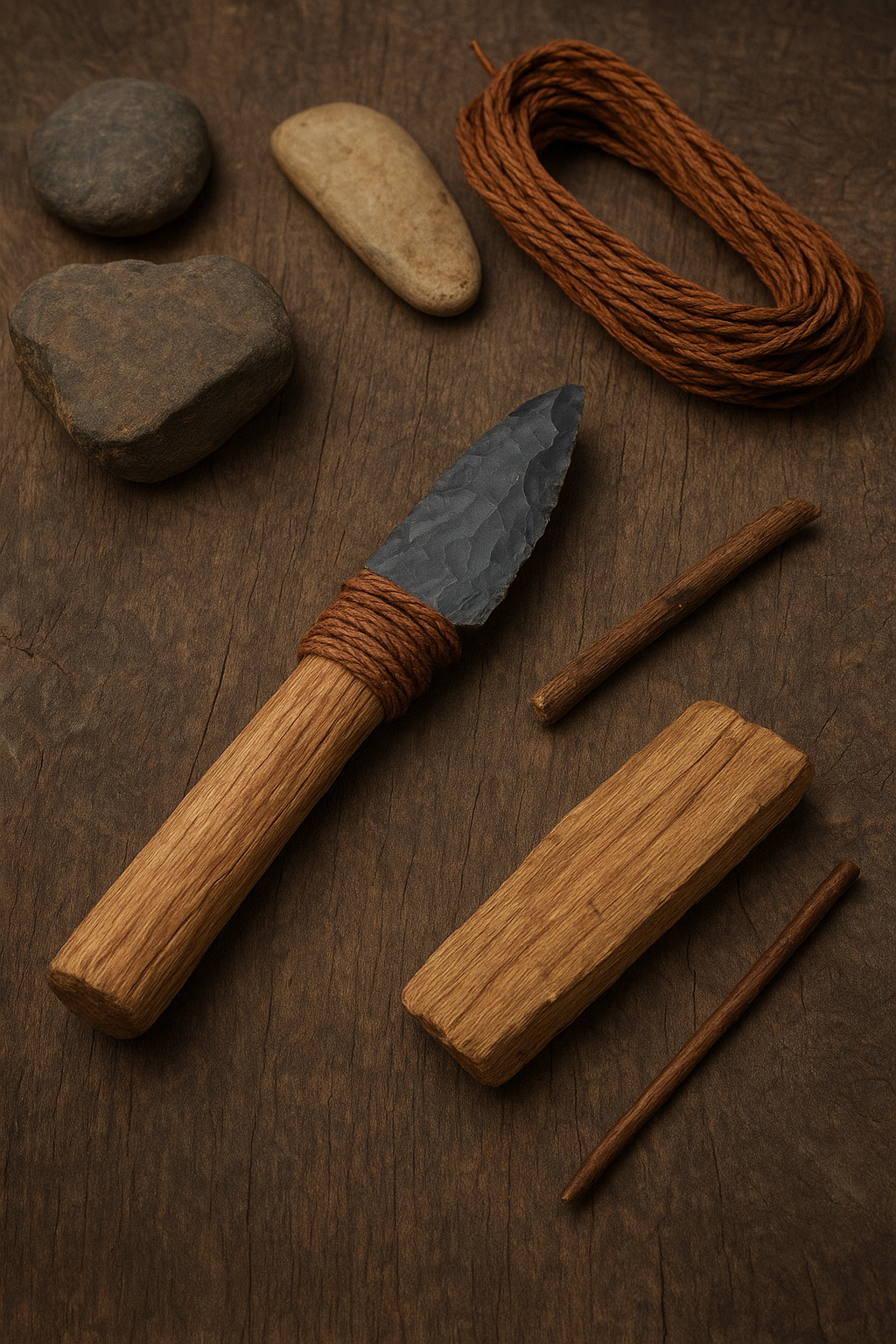

When your gear fails, gets lost, or freezes solid, there’s only one thing left between you and the cold world outside: your ability to create tools from nothing. Primitive tool-making is not a “cool bushcraft trick” — it is a survival multiplier that turns raw nature into weapons, shelter, food, and fire.
In this post, you’ll learn exactly how to craft cutting edges, knives, and axes using only stone, wood, and plant fibers — the same techniques humans relied on for thousands of years to stay alive.
🔥 Step 1: Choosing the Right Stone — The Heart of Your Primitive Blade
Not every rock can become a knife. Most will crumble, split wrong, or dull instantly. Survivalists always look for stones with conchoidal fracture — meaning they break like glass, creating razor-sharp edges.
The best options in the wild:
✅ Flint — sharpest edges, easy to shape
✅ Chert — great for beginners, breaks clean
✅ Obsidian — volcanic glass; scalpel-level sharp
✅ Quartzite — harder to work, but very tough
Field test: Tap the stone with another rock. If it rings like glass instead of a dull “thud,” you’ve found a good candidate.
🔥 Step 2: Knapping — Turning a Raw Stone Into a Blade
Knapping is the art of breaking stone intentionally.
There are two main methods:
1. Hard Percussion Knapping
You strike a stone core with a harder rock (like granite) to remove large flakes.
This gives you the general blade shape.
2. Soft Percussion + Pressure Flaking
Now you switch to antler, bone, or a softer stone to refine edges.
You push off tiny controlled flakes, making the blade:
-
sharper
-
thinner
-
more durable
-
more symmetrical
A properly knapped blade should glide through bark and even cut hide.
🔥 Step 3: Turning a Stone Blade Into a Full Primitive Knife
A blade alone is useless if you can’t hold it.
How to attach the blade to wood without any modern tools:
1. Choose Your Handle Wood
Survival-grade options:
-
Birch
-
Maple
-
Hickory
-
Oak
These woods stay strong in cold and don’t crack easily.
2. Split the Handle
Use a wedge-shaped stick or another stone to split the wood halfway.
Insert the stone blade carefully.
3. Bind It Tight
Primitive cordage options:
-
Strips of bark (cedar, basswood, willow)
-
Rawhide soaked in water
-
Plant fibers twisted into rope
-
Pine roots
When rawhide dries, it shrinks like steel bands — locking the blade permanently.
4. Seal With Natural Glue (Optional but Powerful)
Mix:
-
melted pine resin
-
powdered charcoal
-
crushed dry bark
This creates primitive epoxy strong enough for chopping.
🔥 Step 4: Building a Primitive Axe — Your Most Important Survival Tool
A stone axe gives you:
-
shelter
-
firewood
-
traps
-
spears
-
defensive tools
-
carving abilities
The Key: The Groove System
Instead of trying to shape stone into a “modern axe,” ancient survivalists carved grooves around a stone head using:
-
sand
-
water
-
friction on a flat rock
It takes time, but the result is an axe head that can be tied to a wooden handle securely.
Mounting the Axe Head
-
Carve a V-shaped notch in a heavy hardwood branch.
-
Fit the axe head snugly inside.
-
Wrap with cordage using a figure-eight pattern.
-
Coat with pine resin glue for extra stability.
This creates an axe capable of splitting logs, shaping beams, and cutting down small trees — all without metal.
🔥 Step 5: Maintaining Your Primitive Tools in Harsh Winter Environments
Cold destroys weak blades. Here’s how to keep your tools alive:
❄️ Keep stone edges dry — moisture + freeze cycles cause cracks
❄️ Wrap handles with bark or hide — prevents wood from shrinking
❄️ Carry blades close to your body to avoid extreme temperature shock
❄️ Resharpen often — stone edges dull quicker in winter survival conditions
Primitive tools aren’t immortal — but they’re repairable anywhere.
🔥 Final Takeaway
When the modern world disappears — batteries die, steel rusts, gear breaks — primitive toolmaking becomes more than a skill.
It becomes freedom.
With nothing but stone, wood, and fire, you can create:
-
knives
-
axes
-
scrapers
-
spears
-
traps
-
shelters
-
weapons
This is the foundation of all survival.