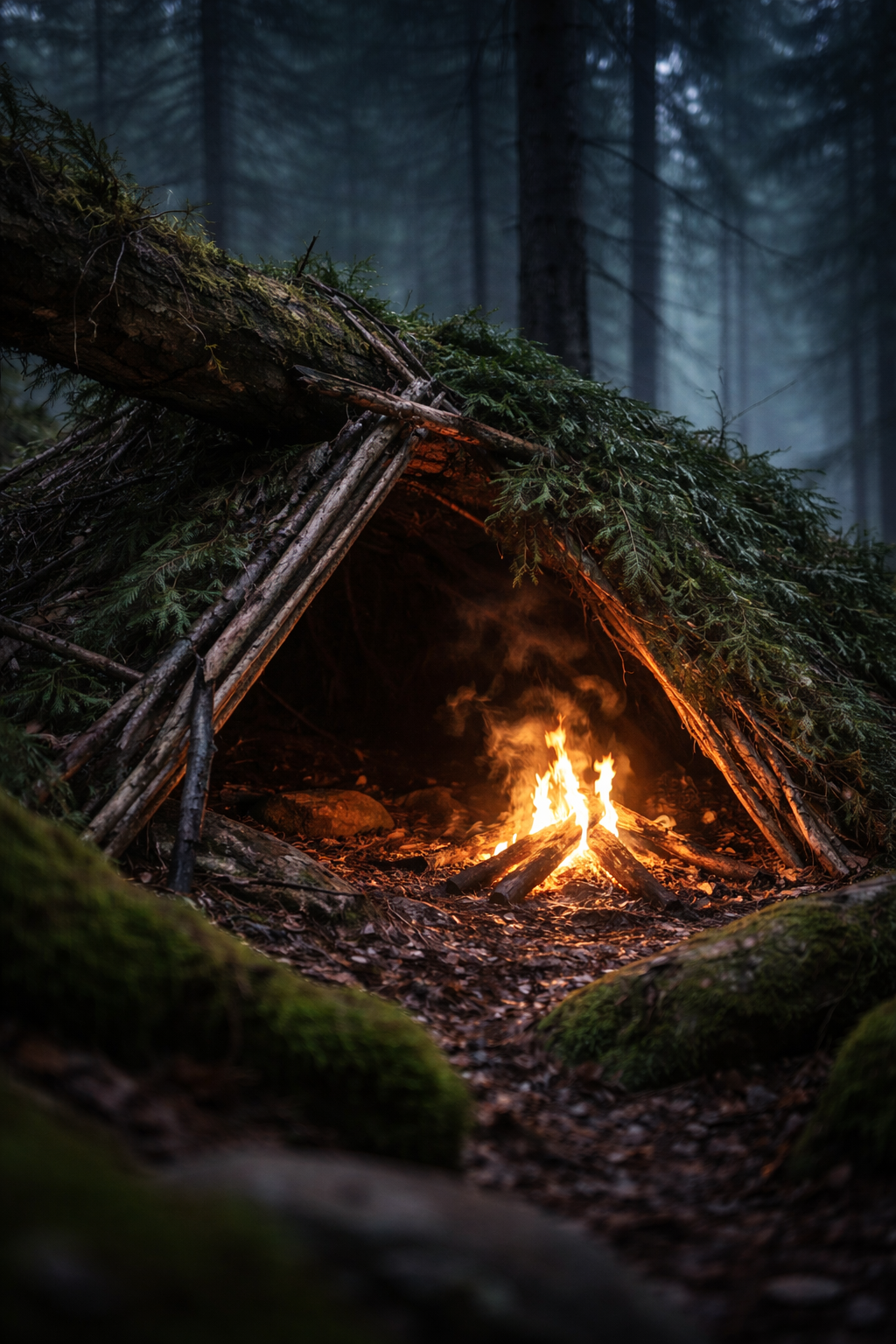

Most people think shelter is about comfort. It’s not. It’s about survival against time, temperature, and exposure. In the wild, you don’t die because it’s “cold” — you die because your body slowly loses the ability to stay warm.
Your shelter is your second skin.
Before you build anything, stop and read the environment. Wind direction matters more than aesthetics. Cold air moves low, wind cuts through open ground, and moisture kills faster than low temperature. If you build in the wrong place, even a “perfect” shelter becomes useless.
Look for natural protection first. Fallen trees, rock formations, thick bushes — these are already doing half the job. The best survival builders don’t create from nothing, they improve what already exists.
Your goal is simple: block wind, trap heat, stay dry.
A common mistake is building shelters that are too big. Large space feels safer psychologically, but it’s harder to keep warm. Build small. Tight. Just enough space for your body. Your heat is the only heater you have.
Insulation is everything. The ground will steal your warmth faster than the air. Pile leaves, grass, pine needles — anything dry — under your body. Think in layers. The thicker, the better.
For the structure, a simple lean-to works in most environments. One strong branch as a spine, smaller branches leaning against it, then covered with debris. The more chaotic it looks, the better it traps heat and blocks wind.
If you have fire, place it strategically. Not too close to burn your shelter, not too far to lose heat. A reflective wall (rocks, logs) behind the fire can push warmth back toward you — this can be the difference between shivering and sleeping.
And one more thing people forget: build your shelter before you need it. Darkness turns simple tasks into dangerous ones. Cold makes your hands slow. Panic makes your decisions worse.