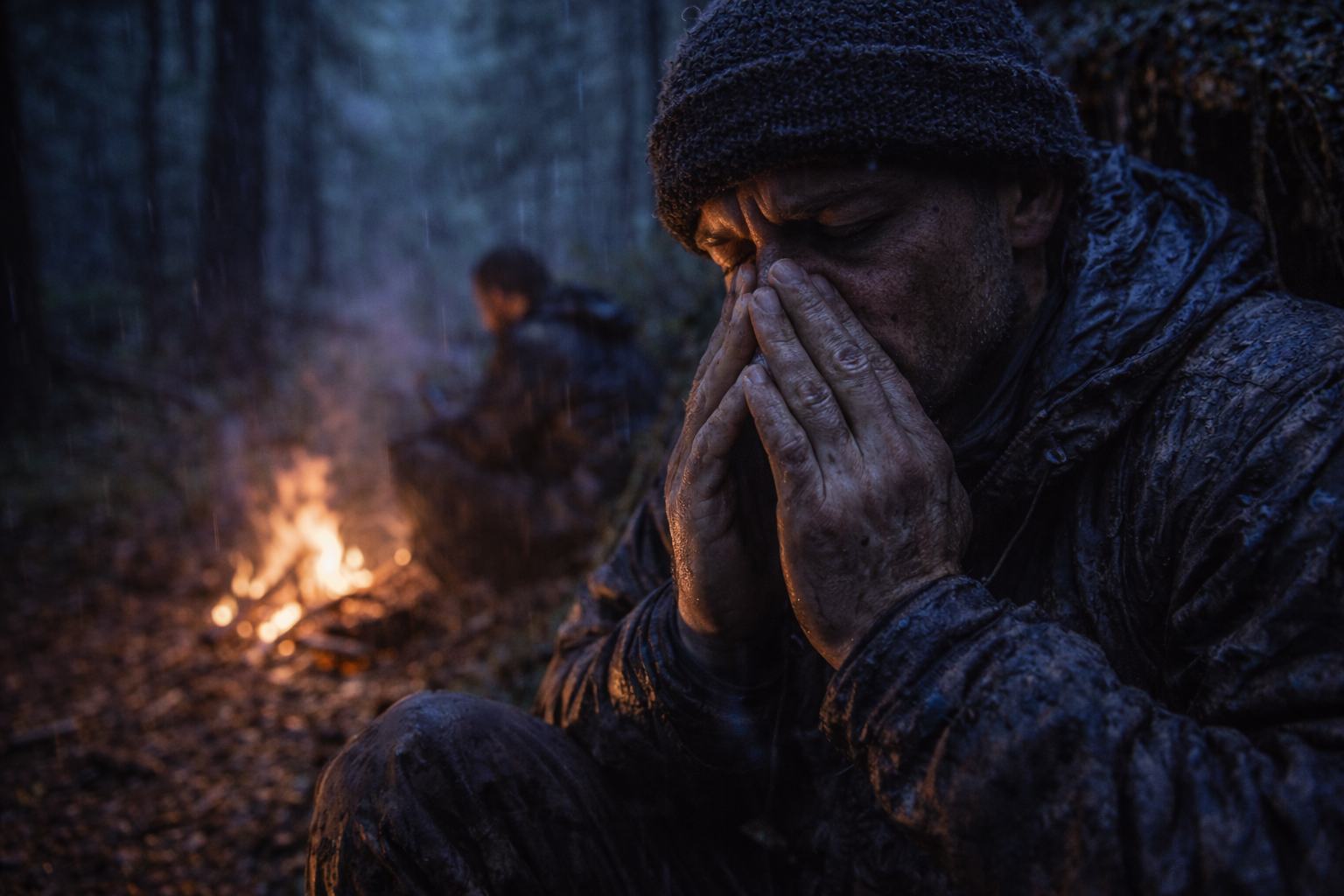

Panic feels natural.
Control does not.
And that’s the problem.
In real survival situations, the people who live are rarely the strongest or the most skilled. They are the ones who retrain their instincts—sometimes in minutes—to stop reacting like prey and start thinking like survivors.
This post explores how real survivors, indigenous cultures, and modern survival experiments prove one thing:
The human mind can be rewired under pressure — if you know how.
🧠 Why Panic Exists (and Why It Betrays You)
Panic evolved for short-term danger:
- Predator attack
- Immediate threat
- One fast decision
But wilderness survival is long-term stress:
- Cold
- Hunger
- Uncertainty
- Darkness
- Isolation
Your brain keeps screaming “DO SOMETHING NOW” — even when doing nothing is smarter.
Survivors don’t eliminate fear.
They delay action until fear loses control.
⏱️ Technique 1: Forced Delay (The 90-Second Rule)
Experienced survivors use a simple rule:
No major decision for the first 90 seconds of panic.
Why it works:
- Adrenaline spikes peak and drop fast
- Heart rate stabilizes
- Tunnel vision fades
In survival experiments, people who paused:
- Chose better shelter locations
- Avoided injuries
- Conserved 30–40% more energy
Stillness is not weakness.
It’s a weapon.
🌬️ Technique 2: Breath Control Over Thought Control
Trying to “calm down” mentally fails.
Survivors control the body first:
- Slow nasal breathing
- Longer exhales than inhales
- Grounding posture (knees bent, hands relaxed)
This shuts down panic pathways without thinking.
Ancient hunters, monks, and modern special forces all discovered the same truth independently:
The breath commands the mind, not the other way around.
👁️ Technique 3: Sensory Narrowing (Seeing Reality Again)
Panic distorts perception:
- Sounds become threats
- Shadows become predators
- Movement feels urgent
Survivors retrain attention using a simple scan:
- Name 3 sounds you hear
- Identify 2 physical sensations
- Focus on 1 stable object
This pulls the brain out of imagination and back into actual surroundings.
Fear feeds on unknowns.
Observation starves it.
🧭 Technique 4: Task Anchoring
The mind spirals when it has nothing to hold.
Survivors anchor themselves to small, physical tasks:
- Stack 10 stones
- Clear a 1-meter area
- Gather exactly 5 sticks
These actions:
- Restore a sense of control
- Break panic loops
- Rebuild confidence through motion
Big plans kill clarity.
Small actions rebuild it.
🔥 Technique 5: Mental Reframing Used by Early Humans
Primitive cultures didn’t ask:
“How do I escape this?”
They asked:
“How do I survive here?”
This shift changes everything:
- You stop fighting the environment
- You start reading it
- You stop rushing toward imaginary safety
Acceptance doesn’t mean surrender.
It means working with reality instead of against it.
⚠️ The Hard Truth
You cannot train panic away in comfort.
But you can train:
- Delay
- Breath
- Observation
- Small action
- Acceptance
Survivors don’t suppress instinct.
They redirect it.
That’s the difference between fear controlling you — and you using fear as information.