Why the Brain Lies After Dark
In low light, the human brain switches from detail recognition to pattern prediction.
Instead of seeing what is, it guesses what might be.
This is efficient — but risky.
At night:
- Shadows stretch and move unnaturally
- Sounds travel farther and distort direction
- Peripheral vision becomes unreliable
Your brain fills the gaps with meaning. Often, the wrong meaning.
The Most Common Night Illusions
1. The “Approaching Footsteps” Effect
Wind moving through leaves often mimics irregular walking patterns. The brain interprets rhythm as intent.
2. Shapes That “Shift” When You Look Away
Low contrast causes the eyes to lose object edges. When you refocus, the brain redraws the shape slightly differently — creating the illusion of movement.
3. Sudden Silence
Many believe silence means danger. In reality, it often means animals paused because you moved.
Silence is not a signal of attack.
It’s usually a signal of attention — followed by withdrawal.
Why Your Imagination Becomes Your Enemy
Fear amplifies memory. The brain replays:
- Stories you’ve heard
- Movies you’ve seen
- Worst-case scenarios
This is not intuition — it’s mental noise.
Primitive humans reduced this by:
- Staying seated at night
- Limiting head movement
- Avoiding constant scanning
Less motion = fewer false signals.
The Survival Technique That Stops Night Fear
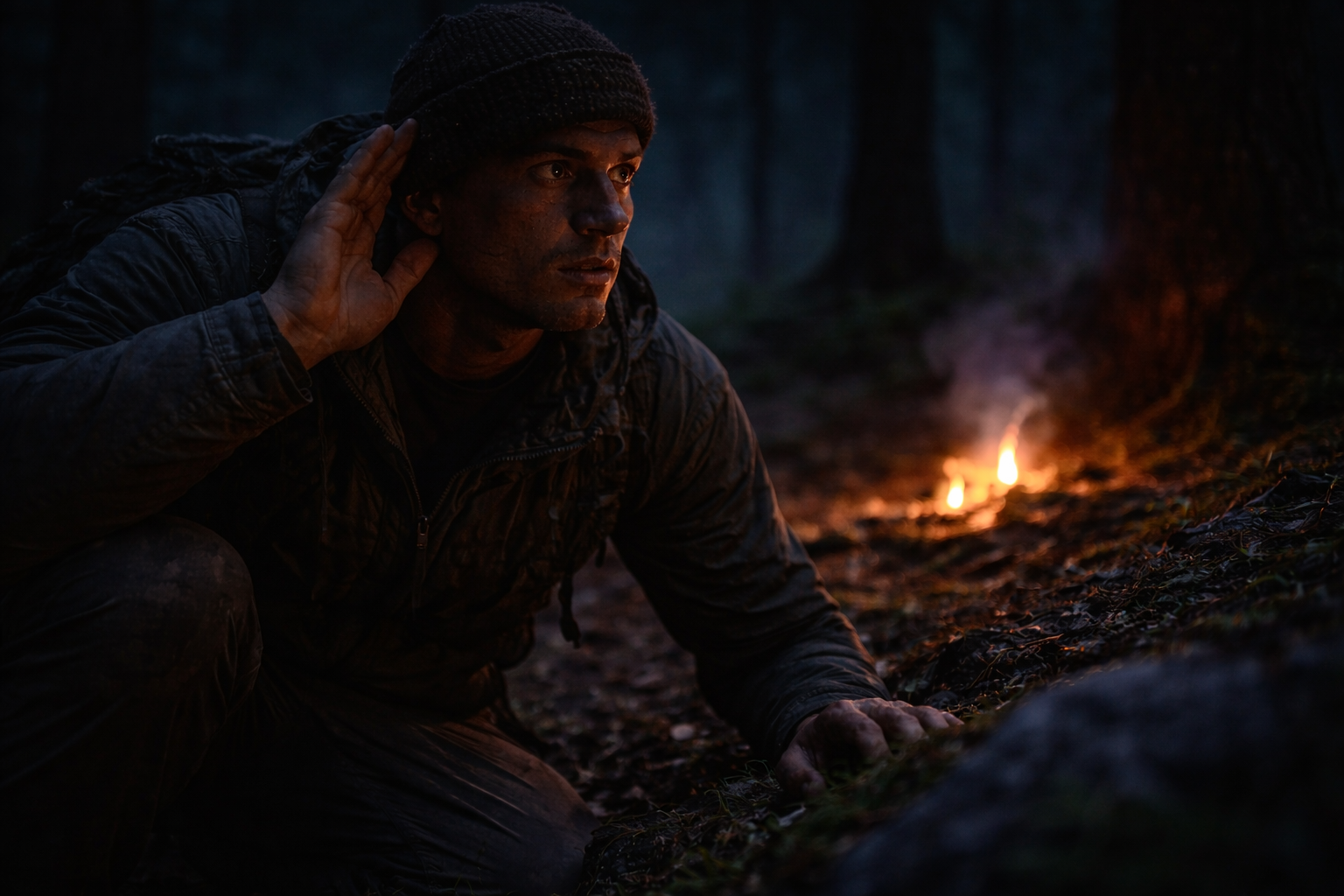
Early humans didn’t stare into darkness.
They listened longer than they looked.
Hearing provides more accurate information at night than vision.
If a sound:
- Repeats naturally → environment
- Changes rhythm → animal
- Stops entirely → awareness, not aggression
Understanding rhythm removes mystery.
Why Stillness Beats Confidence
Confidence makes people move.
Movement creates noise.
Noise creates imagined threats.
Stillness reduces false input — and gives your brain time to correct itself.
Most night fears dissolve within minutes if you don’t react to them.
The Rule That Keeps You Grounded
If you can’t confirm a threat using at least two senses, assume it’s not real.
Darkness doesn’t create danger.
It creates uncertainty.