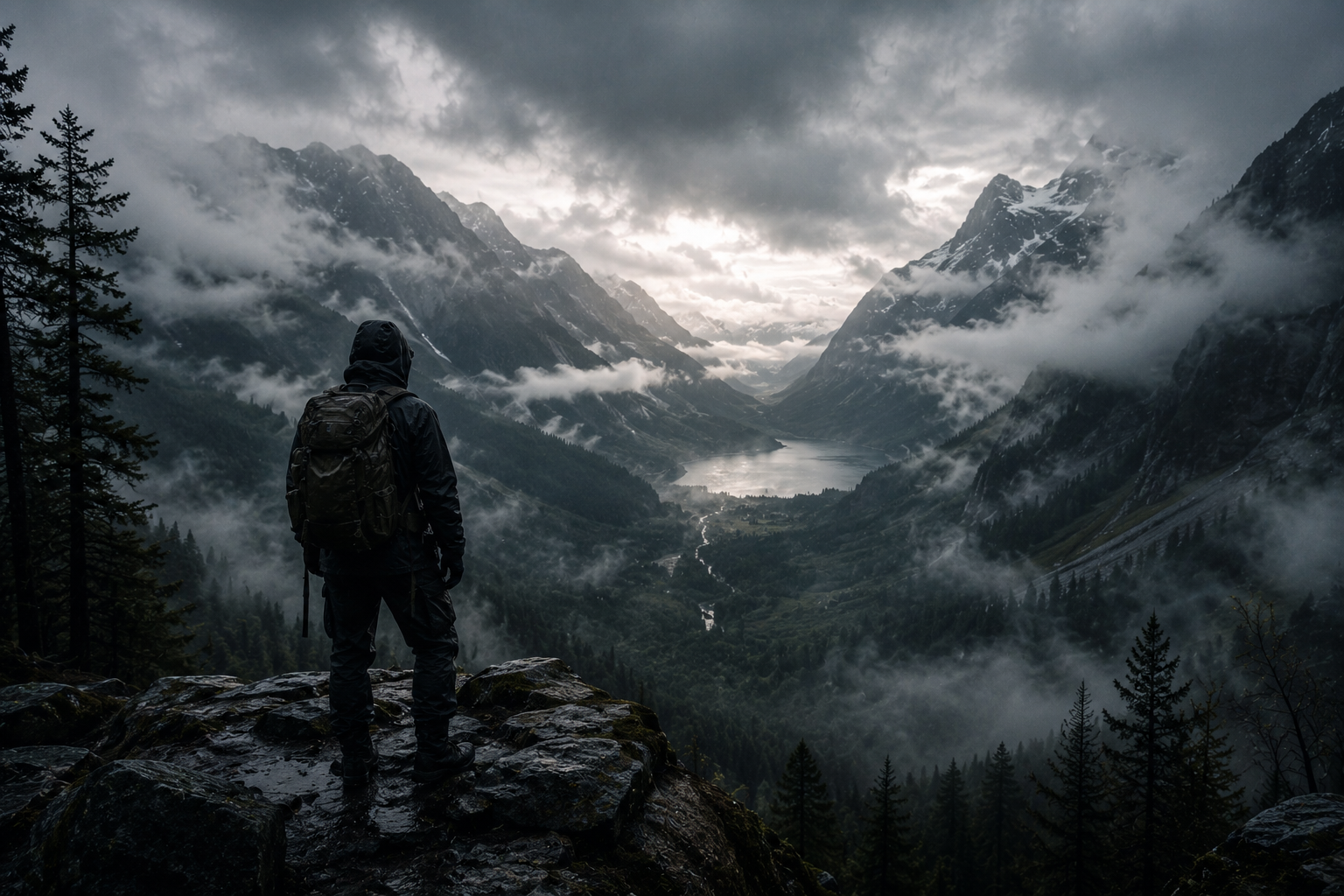

Most people imagine survival as a physical battle.
Cold.
Hunger.
Exhaustion.
Injury.
But deep wilderness rarely destroys people that way first.
It starts psychologically.
The mountains do something strange to the human mind when you stay inside them long enough. Distance changes your perception of reality. Silence becomes heavy. Time stops feeling normal.
You begin measuring life differently.
By daylight.
By temperature.
By how much energy remains in your body.
And eventually, the outside world starts feeling less real than the terrain around you.
That transition is dangerous.
Because isolation changes the way people think.
At first, the wilderness feels cinematic.
Beautiful.
Almost spiritual.
Fog rolling through valleys.
Storms crawling across distant peaks.
Forests moving under the wind like living things.
People romanticize these moments because they experience them briefly.
But prolonged exposure changes the experience completely.
The silence stops feeling peaceful.
It starts feeling endless.
You become hyperaware of every sound.
Every movement.
Every shift in weather.
Your brain never fully relaxes because the environment never fully stops demanding attention.
This is one of the least understood parts of survival:
the wilderness creates mental fatigue long before physical collapse begins.
Decision-making becomes slower.
Small problems feel larger.
You hesitate more.
You second-guess direction, timing, and risk.
And once uncertainty enters your thinking, the environment becomes far more dangerous.
Experienced survivors understand something critical:
Morale is equipment.
A strong mindset preserves energy.
It protects decision-making.
It prevents emotional reactions during stress.
Because in remote environments, panic rarely looks dramatic.
Usually it looks quiet.
Rushed movement.
Poor navigation.
Ignoring exhaustion.
Taking unnecessary risks because the mind wants escape more than safety.
The wilderness does not need aggression to break people.
Sometimes all it needs is enough silence… and enough time.
And the people who survive longest are usually the ones who learn how to stay mentally stable even when the world around them feels endless.