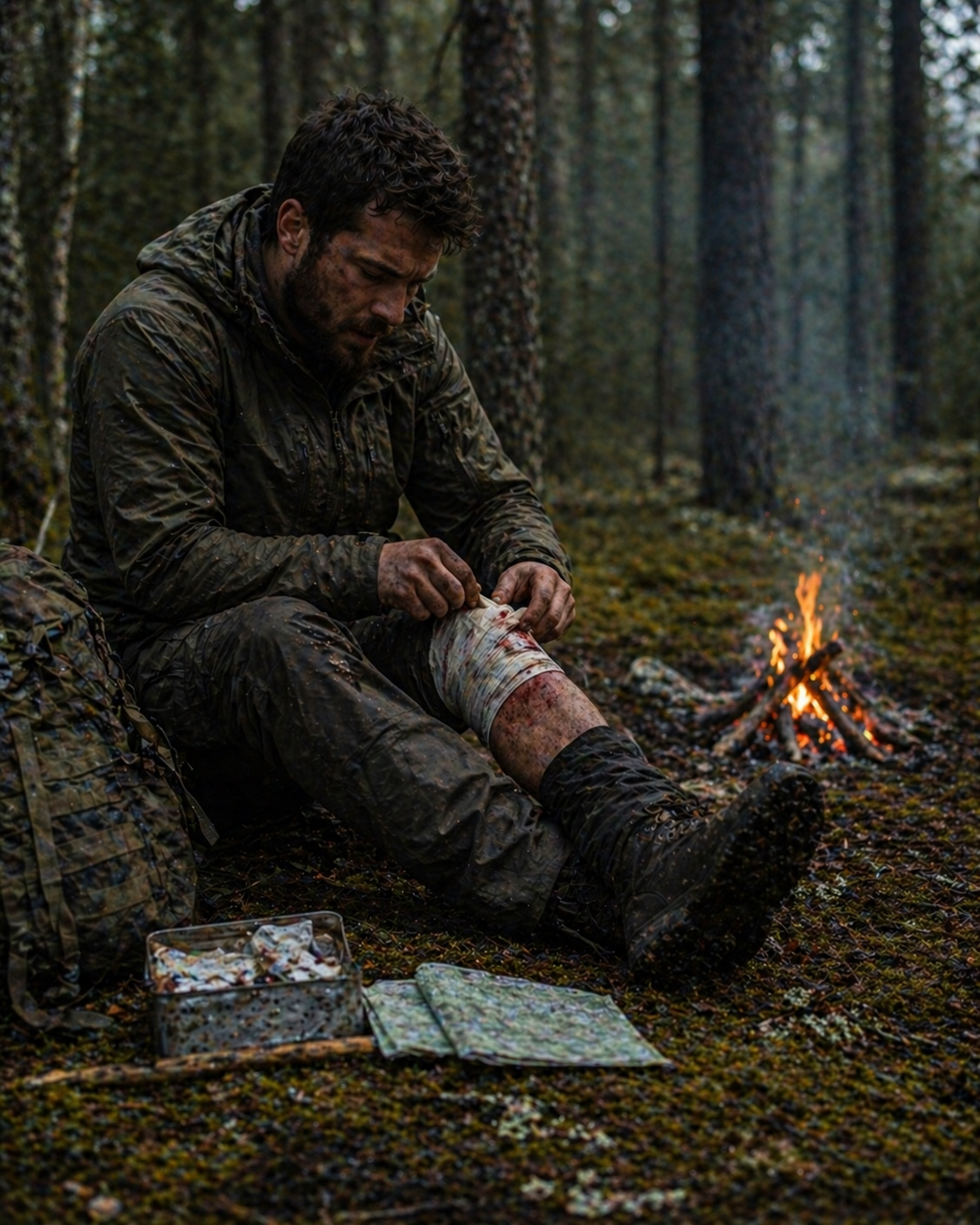
In the wild, injury changes everything instantly.
A simple cut becomes a problem. A twisted ankle becomes a decision point. And something more serious turns survival into a race against time.
But the real danger isn’t the injury itself.
It’s how you react to it.
Most people rush. They panic, try to “push through,” keep moving like nothing happened. That’s how small injuries become serious ones.
So the first step is the hardest:
Stop.
Sit down. Control your breathing. Assess what actually happened. Pain can lie to you — sometimes it feels worse than it is, sometimes not as bad as it really is. You need clarity, not reaction.
Bleeding comes first.
If there’s blood, you deal with it immediately. Pressure. Direct, constant, no hesitation. Blood loss weakens you faster than almost anything else.
Then stability.
If something is sprained or broken, movement becomes your enemy. Use what you have — sticks, clothing, gear — to create support. You’re not trying to fix it. You’re trying to prevent it from getting worse.
Now comes the real decision:
Do you stay or move?
If you can’t move safely, you don’t move. You shift into survival mode where you are — shelter, fire, signal. If movement is possible, it has to be controlled, slow, intentional. No rushing. No risk.
Pain will drain your energy.
Not just physically, but mentally. It wears you down, makes you impatient, pushes you toward bad decisions. You have to manage it by managing your actions — slow, precise, minimal.
And infection is the silent threat.
Even a small wound can become dangerous over time. Keep it clean. Keep it covered. Do what you can with what you have.
But here’s the part most people don’t expect:
Your mindset becomes more important than your body.
Because once you’re injured, survival is no longer about speed or strength.
It’s about discipline.
Every step matters more. Every decision costs more. Every mistake has consequences.
And the only way out… is through careful, controlled action.