Most people think getting rescued is about luck.
It’s not.
It’s about being visible in a world that doesn’t notice you.
You can be a few hundred meters away from a search team and still remain invisible if you don’t understand one thing: the human eye doesn’t look for you — it looks for contrast, movement, and patterns that don’t belong.
So you don’t hide in the wild.
You break it.
Start with visibility from above.
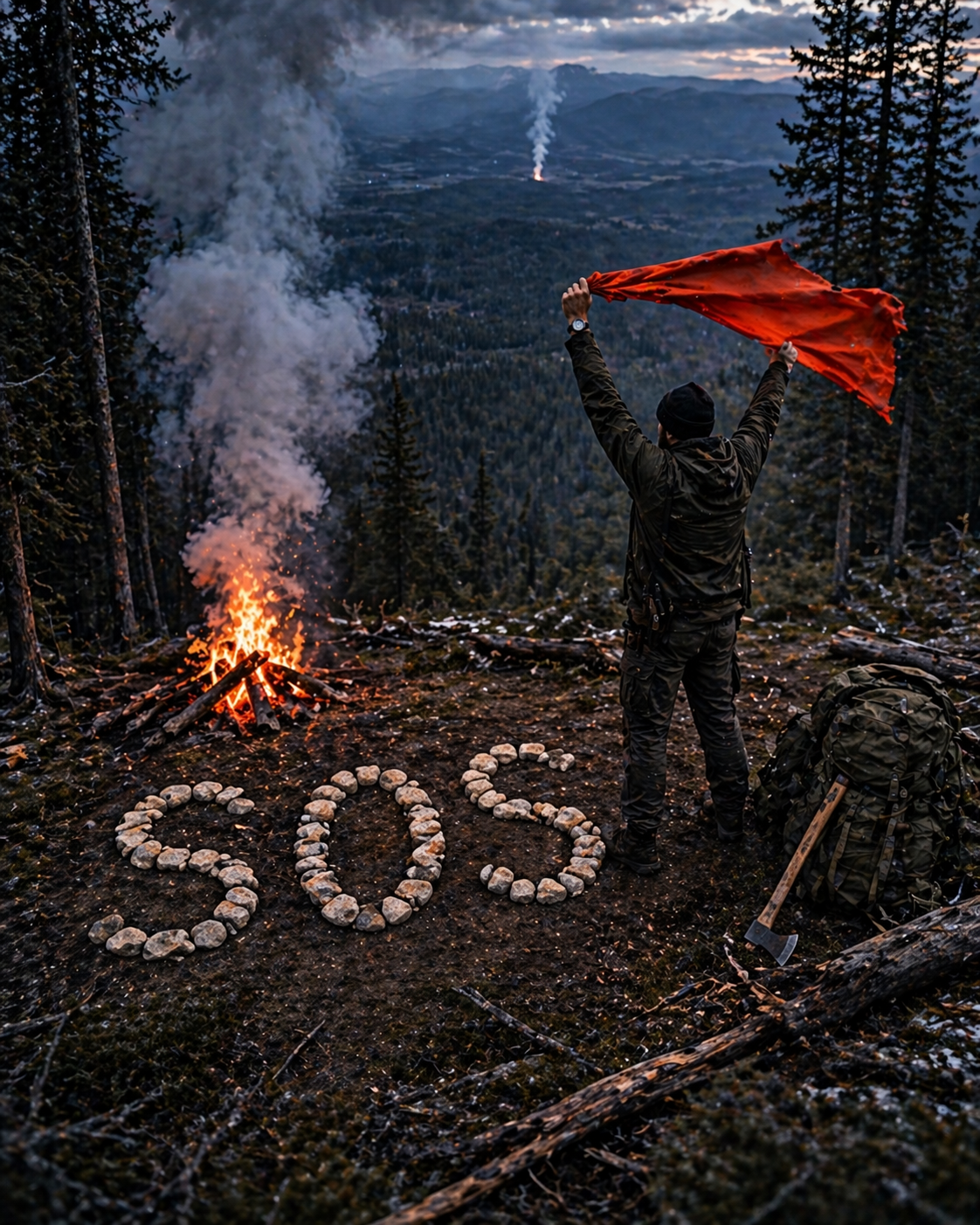
If someone is searching, there’s a high chance it’s from the air. That means your signals must be large, unnatural, and obvious. Small signs don’t work. Subtlety doesn’t work. Think big — logs arranged in shapes, rocks placed in lines, anything that stands out against the natural environment.
Three of anything is a signal.
Three fires. Three piles of stones. Three marks in the ground. This is a universal distress pattern. It tells anyone who sees it: this is not random.
Fire is your strongest signal.
During the day, smoke carries your presence further than your voice ever could. Green leaves, damp wood — they create thick, visible smoke. At night, flame becomes your beacon. Light moves. It attracts attention.
But fire alone is not enough if it’s hidden.
Place it where it can be seen — open ground, clearings, higher elevation if possible. A perfect fire in the wrong place is useless.
Movement saves lives.
Static objects are easy to miss. But something that moves — a piece of fabric, reflective material, even your own arms — catches attention fast. If you hear something in the distance, don’t stay still. Become visible.
Sound is secondary, but still important.
Whistles carry further than shouting and use less energy. If you don’t have one, use rhythm. Repeated sounds stand out more than random noise.
And here’s what most people get wrong:
They wait.
They sit and hope someone finds them.
Hope is not a strategy.