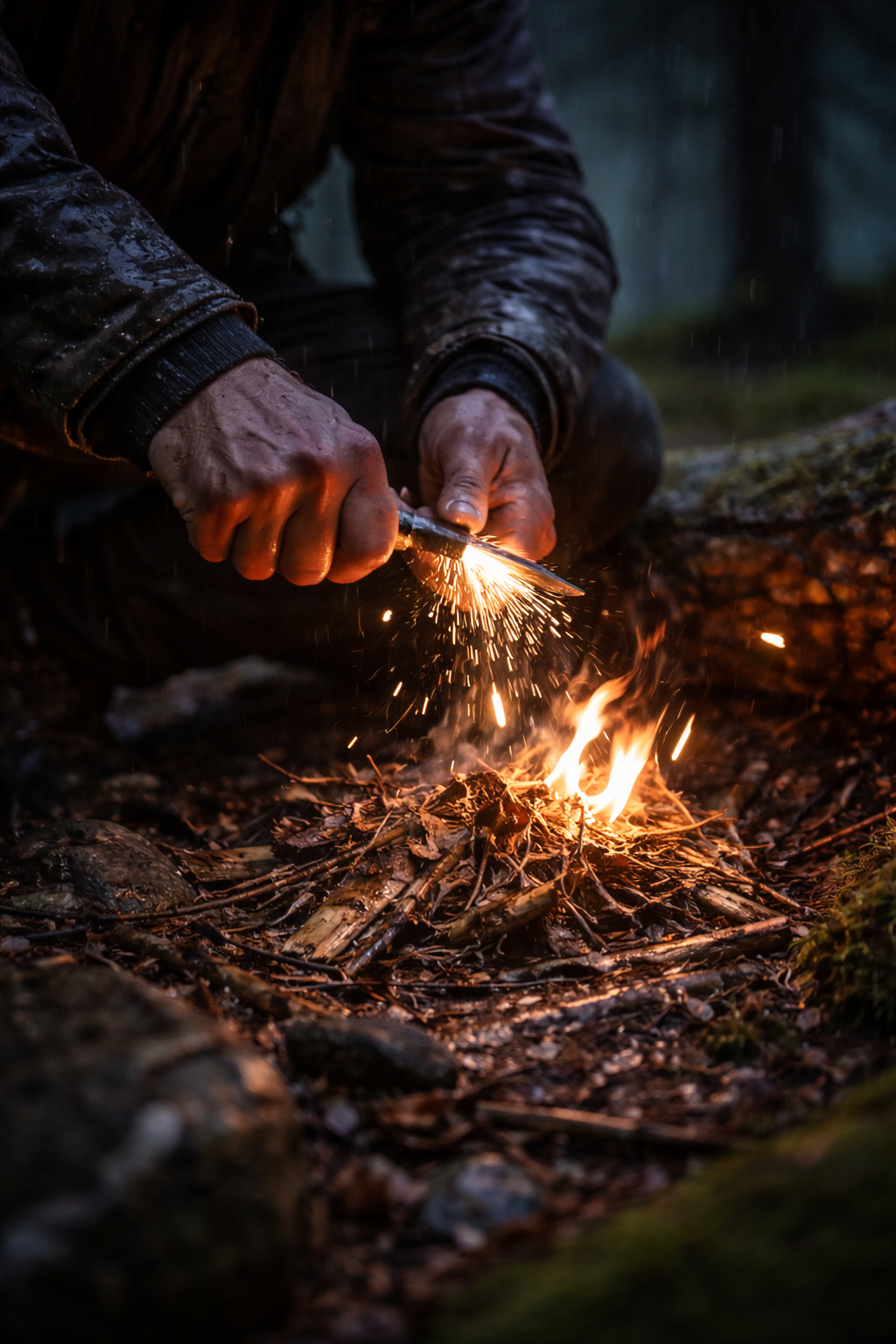

Fire is not just warmth. It’s time. It’s morale. It’s control over a situation that is trying to take control over you.
And the hardest moment to make a fire is exactly when you need it most — when everything is wet, your hands are cold, and daylight is disappearing.
Most people fail not because they don’t have tools, but because they don’t understand one thing: fire is built in layers, not all at once.
Forget big logs. You earn those later.
Your first and only mission is ignition.
Look for dry material where rain doesn’t reach. Under fallen logs, inside hollow trees, beneath dense evergreen branches — nature always hides dry fuel somewhere. Peel bark. Split small sticks. The inside is often dry even when the outside is soaked.
You need something that catches a spark easily. This is your tinder. Dry grass, shredded bark, thin wood fibers — break it down until it feels almost like cotton. The finer it is, the easier it ignites.
Then comes structure.
Most beginners suffocate their fire before it even starts. Fire needs air as much as fuel. Build small, loose, intentional. A fragile beginning is better than a strong failure.
Use your body as a shield. Block wind with your back, your gear, anything. Even a small flame can survive if you protect it in the first seconds.
When it finally catches, don’t rush. Feed it slowly. Respect it. A growing fire is like a living thing — overwhelm it, and it dies. Support it, and it becomes unstoppable.
If you have a knife, make feather sticks — thin curls of dry wood that catch fire easily. If you have anything artificial — a piece of cloth, paper, even a small amount of oil — use it wisely. Survival is not about purity, it’s about results.
And understand this: starting a fire in bad conditions is not just a skill. It’s a mindset.