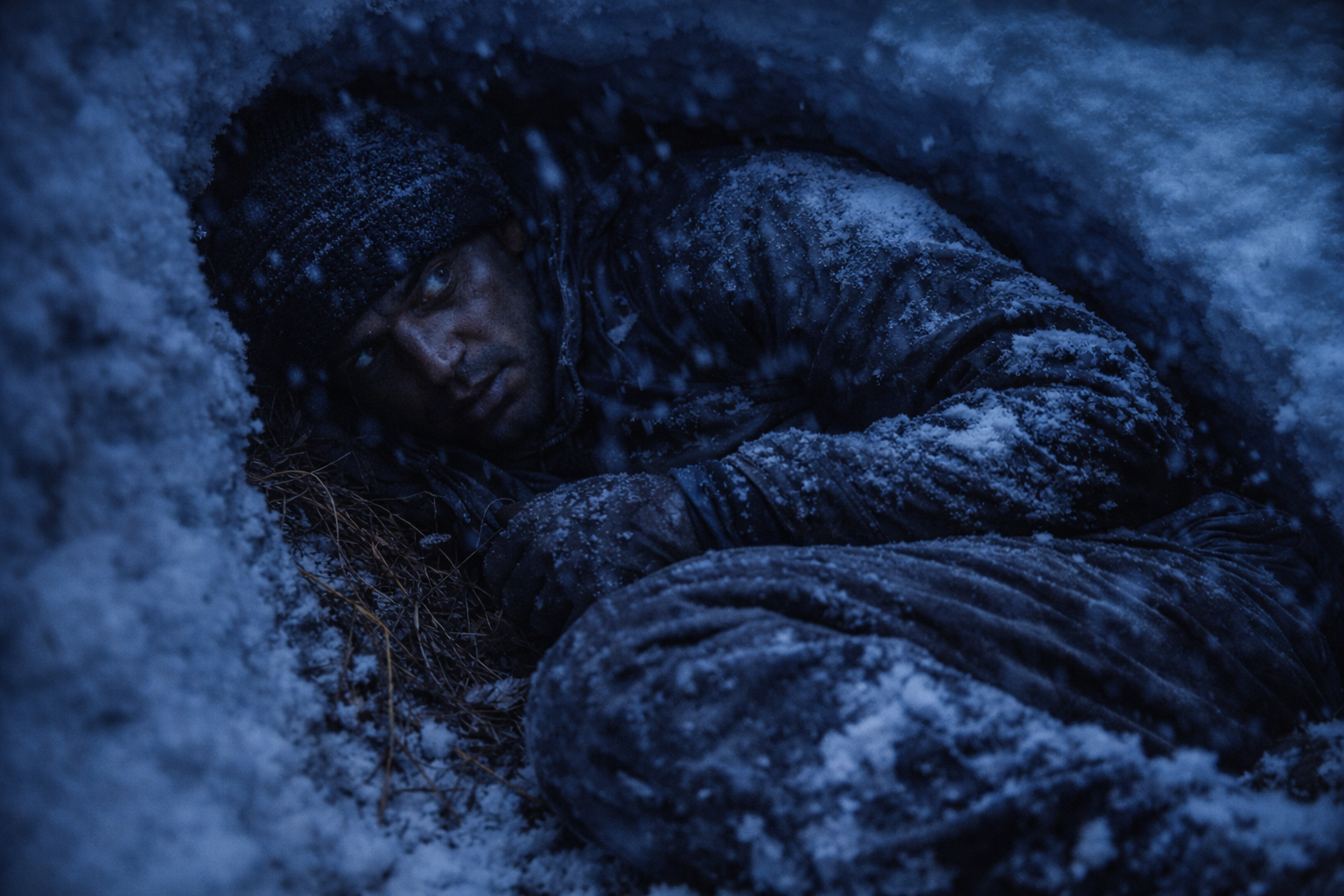

Cold doesn’t kill fast.
It kills quietly—through mistakes.
In real survival experiments and historical cases, people exposed to freezing temperatures didn’t die because they lacked jackets. They died because they misunderstood how cold actually steals heat.
Early humans and modern survivors who lasted through subzero nights followed the same unspoken rules:
1. Still Air Matters More Than Insulation
Many test groups discovered that blocking wind increased survival time more than adding layers. A crude snow wall, earth bank, or fallen log reduced heat loss faster than extra clothing.
2. Ground Is the Silent Killer
Experiments showed body heat drains into the earth faster than into cold air. Survivors who insulated below themselves (branches, bark, dry grass) lasted hours longer than those focused only on covering their bodies.
3. Sweat Is a Death Sentence
Several failed survival trials ended the same way: overexertion, sweat, then rapid hypothermia. Those who moved slowly and stayed dry survived—even with minimal gear.
4. The Body Heats the Space, Not the Air
Primitive shelters weren’t meant to be warm. They were meant to be small. Tight spaces trapped body heat efficiently, turning a human into the heat source.