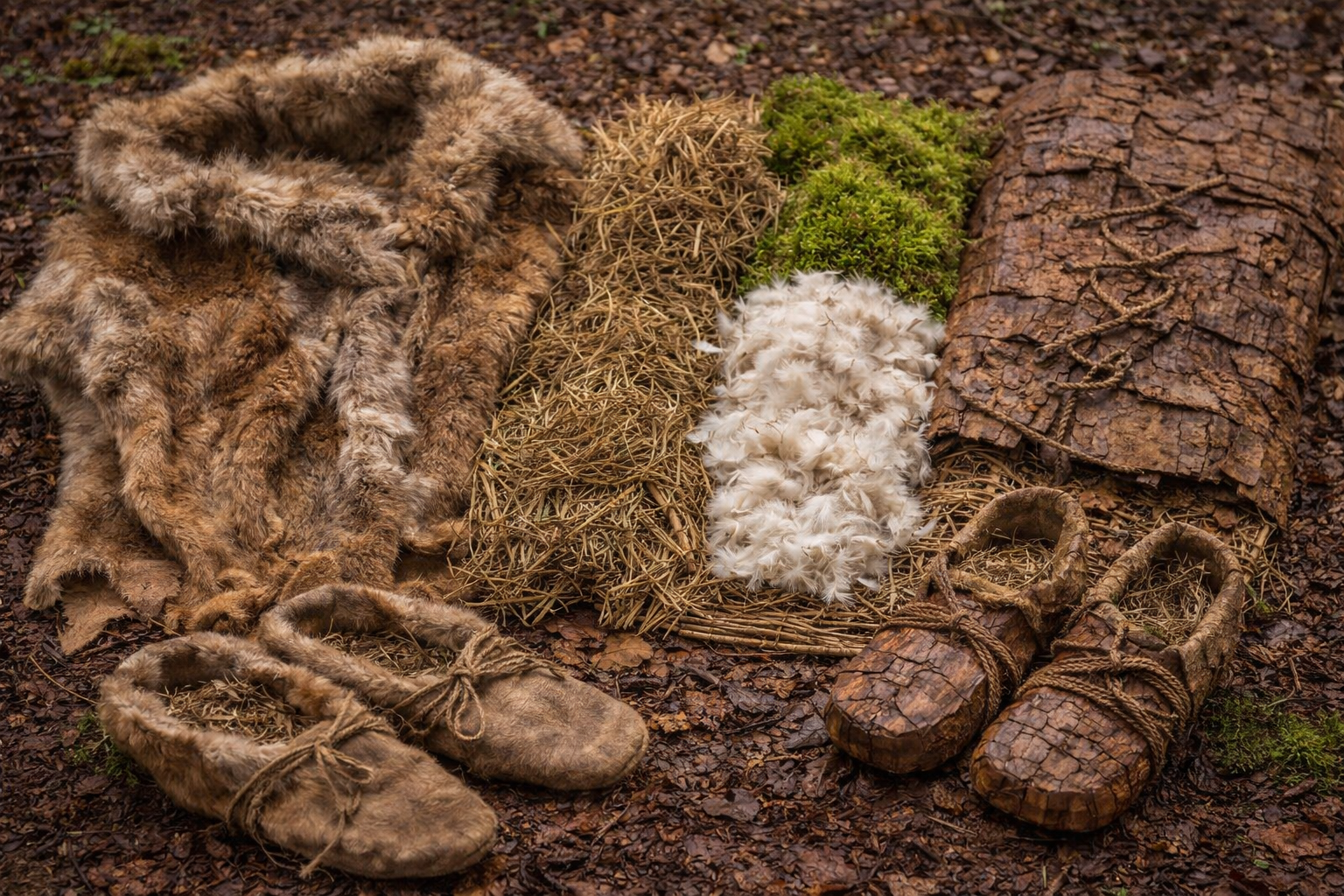

Why Primitive Insulation Still Matters Today
Modern jackets are warm — until they get wet, torn, or compressed. Primitive insulation solved problems that modern gear still struggles with:
-
Wet cold
-
Long-term exposure
-
Lack of resupply
-
Constant movement and rest cycles
Primitive systems were designed to be maintained daily, not worn and forgotten.
The Real Secret: Air, Not Material
Early humans understood one truth intuitively:
👉 Air is the insulation. Materials just trap it.
Fur, grass, feathers, and fibers don’t create heat — they hold warm air close to the body. The more controlled air pockets you trap, the warmer you stay.
This is why loose, layered clothing always beat tight, heavy garments.
Fur: Nature’s Perfect Insulator
Fur is still unmatched in cold, dry conditions.
Why Fur Works So Well:
-
Hollow hairs trap large volumes of air
-
Fur continues insulating even when partially damp
-
Breathable — reduces sweat buildup
Primitive people wore fur inward for insulation and outward for extreme cold, depending on conditions.
Even today, no synthetic fully replicates fur’s balance of warmth and breathability.
Grass & Plant Insulation: Lightweight and Replaceable
In forest and tundra environments, people used dry plant matter as insulation.
Common Materials:
-
Dry grass
-
Reeds
-
Moss
-
Leaves
-
Bark fibers
Used to:
-
Stuff clothing
-
Line footwear
-
Build sleeping layers
Key advantage:
When insulation got wet or crushed, it was replaced — not endured.
Feather & Down Before “Down Jackets”
Bird feathers were used long before modern down gear.
-
Excellent warmth-to-weight ratio
-
Highly compressible
-
Extremely effective in dry cold
Feathers were often sewn or stuffed between hide layers, creating primitive equivalents of modern insulated jackets.
The Primitive Layering System (That Still Wins)
1. Inner Layer — Dry & Breathable
-
Fur
-
Soft plant fibers
-
Grass padding
2. Middle Layer — Structure
-
Leather
-
Woven bark fiber
-
Hide panels
3. Outer Layer — Wind & Weather
-
Oiled hide
-
Bark cloaks
-
Fur worn outward in extreme cold
This system allowed rapid adjustment — removing layers while moving, adding them when resting.
Sleeping Insulation: Where Survival Was Decided
Night killed more people than cold days.
Primitive sleepers insulated:
-
From below (thick grass, branches, hides)
-
Around the body (wraps and cloaks)
-
Above (fur blankets, layered coverings)
Ground insulation was often thicker than clothing, because heat loss into earth is brutal.
Why Primitive Insulation Beats Modern Jackets in Survival
In a true survival scenario, primitive insulation wins because it is:
-
Repairable
-
Replaceable
-
Adaptable
-
Locally sourced
-
Not dependent on factories
Modern jackets are tools. Primitive insulation is knowledge.
Lessons for Modern Bushcrafters & Preppers
Understanding primitive insulation teaches you:
-
How to stay warm without gear
-
How to improvise insulation anywhere
-
How to manage sweat and moisture
-
How to survive long-term exposure
When equipment fails, systems survive.